Monday, 5 November 2012

An unconventional treatment for dementia?

Curry may help combat dementia!Curry may help combat dementia!

Scientists are investigating whether curcumin, a chemical in the spice turmeric, may help to prevent Alzheimer's dementia (AD), the most common form of dementia. Curcumin, a powerful antioxidant and anti-inflammatory, may play a role in clearing the brain of a protein called beta amyloid, which is known to be a causative factor in the development of AD.

India, the largest consumer of turmeric-based curries has the lowest rate of AD in the world.

AD and other forms of dementia are perhaps the single greatest health issue facing Australia in the 21st century, with almost 1 million people in Australia predicted to be living with dementia by 2050. A number of researchers and medical practitioners have recently spoken out about their concerns about the reduction in research dollars spent on finding ways to combat this insidious illness, given the morbidity and prevalence of dementia. Many pharmaceutical companies have stopped or reduced their dementia research programs due to the lack of efficacy of treatments to cure the disease or slow its progress.This is despite advances in neuroimaging technology and diagnostic techniques.

As with most illnesses, prevention is better than cure, and scientists are now focusing on finding ways to stop those at risk of developing AD from doing so.

A clinical trial has started at a Sydney retirement village where 100 residents will take supplements of curcumin and be given MRIs. Ralph Martins, a professor of ageing and Alzheimer's disease at Edith Cowan University, who is conducting the research along with the McCusker Alzheimer's Research Foundation, the Brain and Mind Research Institute and the Royal Prince Alfred Medical Imaging Services, said that:

"What we currently know as clinical Alzheimer's [dementia] is probably the end stage of disease, so the disease is cooking in people's brain for as much as 20 years and what we're finding in the healthy normal people is that a third of them will have this toxic amyloid in their brain".

While the research is promising, there are a range of other lifestyle factors, including diet, exercise and 'brain training' (or stimulation to keep the mind active) that are also important to consider in trying to prevent all forms of dementia.

Curry is certainly not enough, but it may be a good start!

If you are concerned that you or a loved one may be developing dementia, we at ANTS can help. The first step is to read our fact sheet on dementia at:

http://neurotreatment.com.au/neuropsychological-information-dementia.aspx

A thorough neuropsychological assessment is a key component of the diagnosis and management of dementia. If you would like to learn more about what we can offer here at ANTS, please don't hesitate to contact us.

Monday, 22 October 2012

The Neuropsychology of Depression

Ian Thorpe In his recently released autobiography, Ian Thorpe describes how he has suffered from depression most of his life. Like many young Australians with depression, the 30-year old revealed that he kept the illness behind closed doors to the point that not even his family and close friends were aware of his battle with the mental illness, and rather than seeking professional help he would instead often turn to alcohol. He recalls in his book periods of low mood that would often last a month, during which he contemplated suicide.

Depression is not uncommon in young Australians, with approximately 160 000 individuals between the ages of 16 to 24 years of age living with the mental illness. Like Thorpe, a high percentage of sufferers experience suicide ideation and such individuals are at increased risk of completing suicide.

Depression is mainly known for its affect on mood. A lesser known fact is that sufferers also exhibit a number of neuropsychological impairments. Research has shown that individuals with depression have poorer episodic memory and slower psychomotor speed. In addition, those with depression exhibit difficulties with problem-solving, planning and mental flexibility.

The range of cognitive impairments seen in individuals with depression is the consequent of several biological changes in the brain. One of the most widely researched biological dysfunction concerns a deficiency in Serotonin, an important neurotransmitter that is known to mediate memory and learning. Brain MRI studies have shown that, relative to healthy controls, individuals with depression have decreased activity in the frontal lobe, an areas of the brain important for problem-solving, planning and mental flexibility. In addition, research has shown that depressed people exhibit abnormal activity in the amygdala, an area important for processing emotional aspects of information.

Thorpe described that after years of suffering with depression he finally consulted with his doctor who prescribed medication “but little in the way of explanation”. Ironically, he noted that this consultation isolated him further as he felt he "now had a secret and no one to share it with.”

While most antidepressant medications are thought to improve symptoms of depression by correcting deficiencies in Serotonin, they are not affective in addressing the important psychological component of the mental illness, namely negative and maladaptive thinking-patterns. This is usually addressed by supplementing antidepressants with some form of cognitive therapy. Interestingly, there is some preliminary evidence to suggest that cognitive therapies may in themselves alter neural circuitry and normalise abnormal amygdala and frontal activity. Whether these changes lead to corresponding neuropsychological improvements, however, is yet to be determined.

Monday, 24 September 2012

Mental health care for Newton

Successful treatment for Matthew Newton

After a string of assaults and alleged assaults, including domestic violence incidents involving two ex- partners, punching a taxi driver in Sydney and attacking a hotel receptionist in the US, Matthew Newton has recently been released from a high care mental health facility for treatment for bipolar disorder and obsessive compulsive disorder. He previously spent time in a mental health facility in Sydney in late 2010.
His latest treatment has reportedly been a resounding success, with Newton currently free of medication and 'unrecognisable' according to his lawyer, since spending 84 days at the clinic, when he appeared in the Downing Centre Local Court to face charges over the taxi driver assault. His lawyer, Chris Murphy is making a second application to have the matter dealt with under the Mental Health Act, given his diagnoses. An application made earlier this year was rejected.

bipolar brainSection 32 of the Mental Health Act diverts people suffering from mental illness who have been charged with a crime from the criminal justice system and imposes a treatment plan. Charges can be dismissed with the condition that the individual undergo treatment.

Serious psychiatric conditions such as bipolar disorder are known to be associated with higher rates of violence, particularly when an individual is in a manic state.

ABC News Photo Illustration

While this is certainly no excuse for violent behaviour, having a diagnosed mental health condition can help to explain Matthew Newton's actions and can be taken into account as an extenuating circumstance in legal matters. Section 32 of the Mental Health Act exists in part, to help ensure that people who have a mental health condition and engage in criminal behaviour undergo appropriate treatment, which benefits both the individual and the wider community.

As his lawyer made the point via Twitter, you "can't cure mental illness with 'You stop that!'".

With appropriate diagnosis and treatment, most people with mental health conditions can lead happy, safe and fulfilling lives.

Monday, 27 August 2012

Modern day Phineas Gage

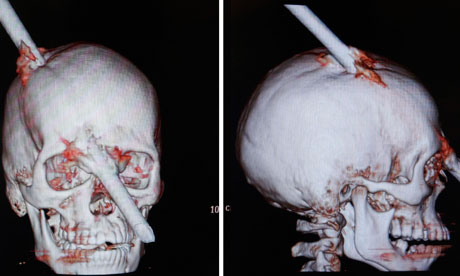
Tomography scans of Eduar

As a psychology student one of the first things you learn about in class is the classic case of Phineas Gage, a 19th century construction worker who was unfortunate enough to have an iron rod driven completely through his head, damaging a substantial part of the left side of his brain, and surviving the whole ordeal.

Phineas Gage, who’s injury resulted in damage to the left frontal lobe, is often documented to have been left with profound behavioural and personality changes, not surprising given that the frontal lobe is responsible for higher mental functions important for social situations, such as reasoning and decision-making.

The case is significant in the field of neuropsychology because it influenced early discussion (and findings) that damage to specific parts of the brain can affect specific functions while leaving other functions intact. The case of Phineas Gage has also been popularised in the media, being mentioned in episodes of shows such as House, Medium and Ripley’s Believe it or Not (Fridge Magnet anyone?).

Amazingly, a 24-year old Brazilian construction worker recently sustained a very similar injury (though the injury was to the right side), and like the classic case, the worker was not only conscious moments after sustaining the injury but he was also able to talk and explain to doctors what happened. The worker reportedly felt little pain and looked as if nothing had happened following the accident.

As can be seen from the photo, the iron bar (which had fallen from the fifth floor of a building) entered the back of the worker’s skull and exited between his eyes. He reportedly narrowly escaped losing one eye and permanent left-sided paralysis.

The doctors who treated the Brazilian worker remarked that the iron bar entered a “non-eloquent” part of the brain that does not have a specific known function. Though, with the patient reportedly still in hospital for at least two more weeks, only time will tell as to whether this man will ultimately develop any of the long-standing behavioural and personality changes sustained by his 19th century counterpart.

As argued by Dr Hamberger, Clinical Neuropsychologist at the Neurological Institute of New York, the lack of reported concern by the worker that a 1.8 metre long iron bar has penetrated his head may be evidence in itself of more subtle higher-level cognitive changes that won’t be immediately apparent before more detailed neuropsychological testing, such as self-awareness and insight.

Wednesday, 11 July 2012

The neuropsychology of smell

The power of the nose

The neuropsychology of smell Have you ever smelt something that immediately took you back to your childhood, to a happy or difficult time in your life or to a certain place? Could you remember exactly how you felt or what you were thinking or doing when you last smelt it, even if it was a long time ago?

It's a common experience to associate an aroma with a memory, which can often arouse quite vivid feelings. The reason that our sense of smell is so powerful is that unlike other senses it does not have to pass through a brain structure known as the thalamus but is directly processed by the olfactory system in the brain. It is also part of the limbic system, which also plays a role in processing emotions and memories.

Compared to many animals, the human olfactory system takes up a relatively small part of the brain and our sense of smell is quite weak. However, the importance of human olfaction is demonstrated by studies that show we can us it among other things, to identify relatives, choose partners and determine age

A new study by Assistant Professor Johan Lundström, an experimental neuropsychologist at the Monell Chemical Sciences Centre in the United States, demonstrates how well we can use our sense of smell to determine age. And debunks the myth that old people smell bad!

Assistant Prof Lundström and colleagues had people from three age groups (20-30 years, 45-55 years and 75-95 years) sleep with pads located under their arms for 5 nights. The pads were then placed in jars and other participants were asked to group the jars according to age. Participants were able to easily group the armpit pads by age group and even by gender.

Surprisingly, despite the common conception that older people have an unpleasant odour, younger people rated the arm pads of the oldest age group as being fairly neutral and not unpleasant.

The group rated as most unpleasant was men aged 45-55 years.

The work of neuropsychologists is varied and valuable. To learn more about what we do and about our services, visit our website

Sunday, 24 June 2012

New research shows promise for children with dyslexics

What is dyslexia?

Dyslexia is a language based problem Dyslexia is a language based problem characterised by a persistent difficulty with reading and spelling. Symptoms include difficulties learning letter-sound relationships, slow and effortful reading and making many mistakes when reading and spelling.

It is largely independent of IQ, meaning that someone with a high or low IQ can have dyslexia. One way that dyslexia is identified is a significant discrepancy between IQ and scores on standardised tests of reading and spelling.

Dyslexia is thought to affect as many as 10% of Australians.

While it does not affect intelligence or learning capacity directly, reading difficulties can affect learning in the classroom as children who can't read well find it hard to keep up with the rest of the class and often have difficulties with not only English but other subjects, particularly those that require absorbing a lot of written information.

A new study has found something that may help!

Researchers from the Department of General Psychology at the Unitersity of Padova have found that reading materials with spacing between the letters can help dyslexic children read faster and better. They found that extra wide letter spacing doubled the reading accuracy and increased reading speed by 20 percent in a sample of 94 dyslexic children aged between 8 and 14 years.

It appears that this approach worked because children with dyslexia are more affected by letter spacing: when letters are too close together they have difficulty identifying letters.

Children without dyslexia did not benefit from the extra wide spacing.

The researchers advised that extra letter spacing could be a way to get children with dyslexia to read more, which is a key way of improving reading skills.

"Practitioners only know too well that getting dyslexic children to read more is a key component in achieving long-lasting improvements in reading skills," says the study. "Extra large letter spacing, which could even be optimised adaptively on an individual basis, can certainly contribute to achieving this goal."

To learn more about dyslexia, see our video explaining dyslexia and what Henry Winkler (Fonzie from Happy Days) did to help manage his condition.


Monday, 11 June 2012

Early detection of mental health issues

Healthy Australian Kids

Early detection of mental health issues The Australian government, supported by the Australian Medical Association (AMA) has proposed an initiative, which will be part of the The Healthy Kids Check, to screen Australian 3 year olds for signs of psychiatric and developmental conditions such as autism

Under this voluntary program parents can bring their children to be assessed by General Practitioners (GPs), who will then refer children who display troubling behaviour to psychologists and paediatricians for further assessment and, if necessary, treatment.