Showing posts with label brain injury. Show all posts

Friday, 17 May 2013

The importance of wearing helmets

Australia is one of the few countries in the world with mandatory helmet laws for motorcyclists and bicycle riders. They were introduced in 1991 in New South Wales and have been the subject of controversy since. A recent study provides evidence supporting the importance of wearing helmets in reducing the risk and severity of head injury, particularly for bicycle riders.

Dr Michael Dinh from the University of Sydney and colleagues studied 348 adult patients admitted to hospitals following bicycle and motorcycle accidents in Sydney for one year between 2008-2009.

They found that cyclists who didn't wear helmets were almost 6 times more likely to suffer a head injury than those wearing helmets, and more than 5 times more likely to suffer a severe head injury. The benefits for motorcyclists were not as marked but still significant, with those without helmets 2 times more likely to suffer a head injury and 3.5 more likely to suffer a severe head injury compared to those without helmets.

Head injuries are rated on a scale from mild to extremely severe, based on a ranges of factors including level of consciousness following the incident and length of coma.

These outcomes also have implications for hospital care. The study found that patients who suffered severe head injuries from not wearing a helmet cost hospitals 3 times as much in treatment. For those who suffered a severe head injury, median hospital costs for non-helmeted patients were $72,000 while for those with helmets the figure was $24,000.

Older riders were more likely to wear helmets than younger riders. The average age of helmet wearing cyclists was 41, compared to 35 for non-helmet wearers, and for motorcyclists the average ages were 31 for those wearing helmets and 25 for those who did not.

The study was published in the Medical Journal of Australia. It supports previous research on the subject. In 2011 Dr Jake Oliver and colleagues from the University of New South Wales and the Sax Institute studied the number of head injuries before and after the mandatory helmet laws came into effect. They found that head injuries fell by up to 29%.

There are clear benefits from helmet wearing that clearly outweigh concerns about mandatory helmet laws reducing the number of cyclists. Studies such as those by Dr Dinh and Dr Oliver have also prompted debate about the usefulness of mandatory helmet laws in the US. More information can be found here.

Tuesday, 22 January 2013

An update on Molly Meldrum

Molly's recovery

Readers may recall that in December 2011 Molly Meldrum was admitted to hospital after a fall at his home in Melbourne. He was in an induced come for approximately 10 days and in Post Traumatic Amnesia (PTA) for almost one month. From the limited details released by the media, Molly appeared to have sustained at least a severe Traumatic Brain Injury (TBI).

It has emerged that on February 27, 2012, less than 10 days after coming out of PTA, Molly checked himself out of hospital. At that point he could walk and talk, was physically much better, had likely had enough of being in hospital and (incorrectly) assumed that he was well enough to go home.

Monday, 27 August 2012

Modern day Phineas Gage

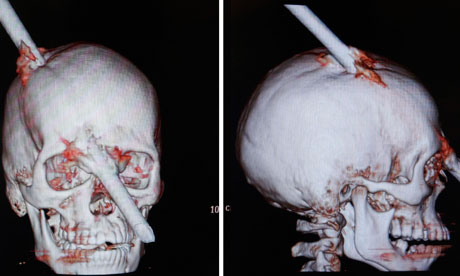
Tomography scans of Eduar

As a psychology student one of the first things you learn about in class is the classic case of Phineas Gage, a 19th century construction worker who was unfortunate enough to have an iron rod driven completely through his head, damaging a substantial part of the left side of his brain, and surviving the whole ordeal.

Phineas Gage, who’s injury resulted in damage to the left frontal lobe, is often documented to have been left with profound behavioural and personality changes, not surprising given that the frontal lobe is responsible for higher mental functions important for social situations, such as reasoning and decision-making.

The case is significant in the field of neuropsychology because it influenced early discussion (and findings) that damage to specific parts of the brain can affect specific functions while leaving other functions intact. The case of Phineas Gage has also been popularised in the media, being mentioned in episodes of shows such as House, Medium and Ripley’s Believe it or Not (Fridge Magnet anyone?).

Amazingly, a 24-year old Brazilian construction worker recently sustained a very similar injury (though the injury was to the right side), and like the classic case, the worker was not only conscious moments after sustaining the injury but he was also able to talk and explain to doctors what happened. The worker reportedly felt little pain and looked as if nothing had happened following the accident.

As can be seen from the photo, the iron bar (which had fallen from the fifth floor of a building) entered the back of the worker’s skull and exited between his eyes. He reportedly narrowly escaped losing one eye and permanent left-sided paralysis.

The doctors who treated the Brazilian worker remarked that the iron bar entered a “non-eloquent” part of the brain that does not have a specific known function. Though, with the patient reportedly still in hospital for at least two more weeks, only time will tell as to whether this man will ultimately develop any of the long-standing behavioural and personality changes sustained by his 19th century counterpart.

As argued by Dr Hamberger, Clinical Neuropsychologist at the Neurological Institute of New York, the lack of reported concern by the worker that a 1.8 metre long iron bar has penetrated his head may be evidence in itself of more subtle higher-level cognitive changes that won’t be immediately apparent before more detailed neuropsychological testing, such as self-awareness and insight.

Wednesday, 18 April 2012

Molly in recovery

Molly Meldrum

Molly's letter

Molly Meldrum, the well known TV personality who suffered a severe head injury after a fall on 15 December last year, appears to be recovering well. He has written an open letter expressing his thanks for the attention and well-wishes he received after his fall.

Part of the letter is reproduced on this news site

Molly said: "My life changed forever when I fell off the roof".

"I can't say my life flashed before my eyes, but I have had plenty of time to reflect in the past few weeks, and I realise just how lucky I am".

"I wish I could reply to all the cards and messages, but it's impossible - it would take all year and I'd never get my book finished!" he wrote.

The letter comes not long after the recording of an interview by journalist Jennifer Keyte which will air on Today Tonight. It will make fascinating viewing.

Prognosis and recovery

Molly appears to be making a good recovery from his head injury, particularly given his age (66) and the severity of his injury. He appears to be alert and very articulate.

However, an article on news.com.au reveals that he also tires easily, becomes stressed under pressure and is walking slowly.

These are common outcomes of head injury or traumatic brain injury (TBI). Depending on many factors, including the severity of the TBI and the part of the brain affected, slowed processing, fatigue and difficulties managing stress are to be expected following a TBI. These can be short or long term effects. Again, depending on a number of factors, many skills are also often retained. These tend to be those skills that have been well practised, such as literacy skills.

The human brain is complex, as are the outcomes of TBI. To learn more about how the outcomes of TBI can be assessed, please contact us

Friday, 20 January 2012

Molly goes into rehabilitation

Ian Molly Meldrum Molly Meldrum has recently been transferred from hospital to a private rehabilitation centre, Epworth Rehabilitation Home.

Reportedly, the focus of his rehabilitation will be on improving his memory. Specifically, according to his brother, Brian, "getting things into the short term memory to the extent that they're passed onto the long term memory". There are ongoing reports that he is disoriented, has memory lapses, can only participate in limited conversation and that his recovery is likely to be gradual and prolonged.

Given his age and the likely severity of his traumatic brain injury, these outcomes are unsurprising. However, a rehabilitation program will ensure that Molly has the best possible recovery.

What is rehabilitation

Rehabilitation can be physical or cognitive, and in the case of traumatic brain injury, usually both. Our focus will be on cognitive rehabilitation.

Cognitive (thinking skills) rehabilitation has two components: restoration of functions that can be restored (remediation) and using intact skills to compensate for impaired skills (compensation). Processes that lend themselves well to restoration are things like unilateral visual inattention, where an individual does not attend properly to objects/information on one side. With practice and use of specific techniques to draw the patient's focus to the neglected side, this can often be restored.

Memory, particularly in cases of severe injury and with older patients, is often very difficult to restore. Compensation is the best option for treating memory problems. Common memory compensation techniques are using calendars, labelling objects, placing commonly used items in the same place each time, asking others to provide reminders and using techniques that optimise use of the memory process least impaired (e.g. if visual memory is better than verbal memory the use of charts/pictures can help).

The first step and the cornerstone of treatment for traumatic brain injury is a thorough neuropsychological assessment to identify level of functioning and pinpoint strengths and weaknesses. For more information about our assessment and treatment services, visit the ANTS website or contact us.

Wednesday, 4 January 2012

Molly Meldrum and TBI in the elderly

Ian Molly Meldrum On 15 December 65 year-old Ian “Molly” Meldrum fell 3 metres downstairs whilst putting up Christmas decorations in his home, striking his head and fracturing his skull. He was hospitalised, sedated and placed on a ventilator to help him breathe.

From the little information released by the media on his condition and recovery since the fall it appears that:
  • Molly was unconscious for several days and possibly more than a week – although it is understood that he was in an induced coma for part of that time
  • He regained consciousness after Christmas but remains disoriented and confused
  • He is only able to respond to basic commands and is unable to carry on a conversation
  • He can recognise close family members at times but this is inconsistent
These factors suggest that Molly sustained a traumatic brain injury (TBI) that was at least in the severe and possibly extremely severe, range.

Today’s ABC news report predicts that Molly has “a very, very long haul ahead of him”.

Research supports this assertion. Older age is an important predictor of worse outcome after TBI, even with relatively minor head injuries. A study by Mosenthal and colleagues (2002) found that elderly patients had twice the in-hospital mortality of younger TBI patients, the mortality rate increasing for each decade over 50 years. Elderly survivors of TBI are more likely to have a severe disability or be in a persistent vegetative state. The incidence of complications and poorer outcome after surgery are also worse for older patients.

The best predictors of a favourable outcome following TBI are younger age and lesser severity of TBI.
While this doesn't bode well for Molly, he does appear to be making some progress and all signs are that his functioning will continue to improve. It is also likely that he is getting the best possible care, which can make all the difference in ensuring the best possible recovery.

The thoughts of the ANTS team are with Molly and his family and we wish him a speedy recovery.

If you would like more information about TBI, cognitive rehabiliation or other ANTS services, please contact us.

References
Mosenthal, A.C., Lavery, R.F., Addis, M., et al. (2002). Isolated traumatic brain injury: Age is an independent predictor of mortality and early outcome. Journal of Trauma, 52(5), 907-911.
http://www.couriermail.com.au/news/molly-still-faces-an-uphill-battle/story-e6freon6-1226236078834
http://www.theaustralian.com.au/news/nation/meldrum-remains-in-intensive-care-faces-long-haul-to-recovery/story-e6frg6nf-1226236011605
http://www.heraldsun.com.au/news/more-news/molly-meldrum-recognises-brother/story-fn7x8me2-1226233539168
http://www.clinicalgeriatrics.com/articles/Traumatic-Brain-Injury-Elderly?page=0,8

Thursday, 8 December 2011

World focuses attention on tragic outcomes of road traffic accidents


The ‘Pinky Ad’ and Road Safety

The ‘Pinky Ad’ and Road Safety Who could forget those ads that ran on Australian television a few years ago about young male drivers – the ones with the pinky finger that targeted risky driving in young males by implying that speeding is linked to an inferiority complex to do with, let’s just say, an aspect of the male anatomy.
While the approach was light-hearted (if a bit sexist!), the subject matter is not. Road accidents are the leading killer of people aged between 15 to 29 years. Globally 1.3 million people die each year on the roads and between 20 and 50 million people sustain non-fatal injuries. It is projected that based on current rates, if no action is taken, road accidents will result in 1.9 million deaths by 2020.
Now the world is collectively sitting up and taking notice.

Global Decade of Action for Road Safety

May 11 marked the beginning of the global Decade of Action for Road Safety 2011-2020. The aim of the ‘Decade’ is to prevent death and injury from road traffic events. At least 20 countries, including Australia, are involved in the Decade, their governments having committed to improving safety management and enhancing health and related services.

Road Accidents and Traumatic Brain Injury

The brain and road accidents and Traumatic Brain Injury (TBI) One of the most tragic outcomes of road accidents is Traumatic Brain Injury (TBI). TBI is an acquired brain injury caused by physical damage to the brain, either as a result of an external force striking the head or the brain impacting with the skull. The force causes the brain to move within the skull, causing internal damage.
There are different levels of severity raging from mild to extremely severe which are determined by factors including recall of events before and after the incident and level of coma. The more severe the TBI, the poorer the prognosis.
Cognitive and psychological outcomes can include memory difficulties, difficulties with higher level thinking skills (e.g. planning/organisation), slowed speed of information processing, mood and personality change, depression and anxiety.
A 2008 report by the Australian Institute of Health and Welfare and the Research Centre for Injury Studies found that there were more than 22,700 hospitalisations involving TBI in Australia in 2004-05. After falls, transportation use was the second highest external cause of TBI, at 31% of all cases, which represented over 7,000 people.
Nearly 70% of the cases were males, who acquired TBI at more than twice the rate of females. table of TBI road injury

TBI and Clinical Neuropsychology

While the main aim of the Decade is to prevent TBI, another important aim is to improve management of and services for those who experience a TBI. Clinical neuropsychology is critical in the assessment and rehabilitation of TBI. A neuropsychological assessment can provide detailed information on the impact of the TBI on various aspects of cognition (thinking skills) and expert advice regarding the trajectory of brain recovery and remediation/rehabilitation strategies to allow for the best possible outcome.
If you or someone you know has had a TBI and would like more information on our assessment and rehabilitation services, please contact us.
And please slow down on our roads over this holiday period.