Monday, 27 August 2012

Modern day Phineas Gage

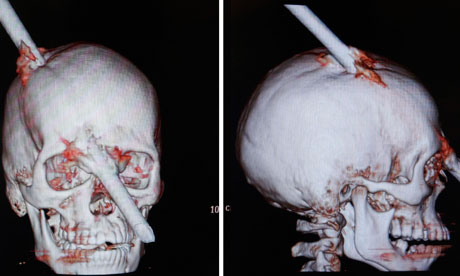
Tomography scans of Eduar

As a psychology student one of the first things you learn about in class is the classic case of Phineas Gage, a 19th century construction worker who was unfortunate enough to have an iron rod driven completely through his head, damaging a substantial part of the left side of his brain, and surviving the whole ordeal.

Phineas Gage, who’s injury resulted in damage to the left frontal lobe, is often documented to have been left with profound behavioural and personality changes, not surprising given that the frontal lobe is responsible for higher mental functions important for social situations, such as reasoning and decision-making.

The case is significant in the field of neuropsychology because it influenced early discussion (and findings) that damage to specific parts of the brain can affect specific functions while leaving other functions intact. The case of Phineas Gage has also been popularised in the media, being mentioned in episodes of shows such as House, Medium and Ripley’s Believe it or Not (Fridge Magnet anyone?).

Amazingly, a 24-year old Brazilian construction worker recently sustained a very similar injury (though the injury was to the right side), and like the classic case, the worker was not only conscious moments after sustaining the injury but he was also able to talk and explain to doctors what happened. The worker reportedly felt little pain and looked as if nothing had happened following the accident.

As can be seen from the photo, the iron bar (which had fallen from the fifth floor of a building) entered the back of the worker’s skull and exited between his eyes. He reportedly narrowly escaped losing one eye and permanent left-sided paralysis.

The doctors who treated the Brazilian worker remarked that the iron bar entered a “non-eloquent” part of the brain that does not have a specific known function. Though, with the patient reportedly still in hospital for at least two more weeks, only time will tell as to whether this man will ultimately develop any of the long-standing behavioural and personality changes sustained by his 19th century counterpart.

As argued by Dr Hamberger, Clinical Neuropsychologist at the Neurological Institute of New York, the lack of reported concern by the worker that a 1.8 metre long iron bar has penetrated his head may be evidence in itself of more subtle higher-level cognitive changes that won’t be immediately apparent before more detailed neuropsychological testing, such as self-awareness and insight.

Wednesday, 11 July 2012

The neuropsychology of smell

The power of the nose

The neuropsychology of smell Have you ever smelt something that immediately took you back to your childhood, to a happy or difficult time in your life or to a certain place? Could you remember exactly how you felt or what you were thinking or doing when you last smelt it, even if it was a long time ago?

It's a common experience to associate an aroma with a memory, which can often arouse quite vivid feelings. The reason that our sense of smell is so powerful is that unlike other senses it does not have to pass through a brain structure known as the thalamus but is directly processed by the olfactory system in the brain. It is also part of the limbic system, which also plays a role in processing emotions and memories.

Compared to many animals, the human olfactory system takes up a relatively small part of the brain and our sense of smell is quite weak. However, the importance of human olfaction is demonstrated by studies that show we can us it among other things, to identify relatives, choose partners and determine age

A new study by Assistant Professor Johan Lundström, an experimental neuropsychologist at the Monell Chemical Sciences Centre in the United States, demonstrates how well we can use our sense of smell to determine age. And debunks the myth that old people smell bad!

Assistant Prof Lundström and colleagues had people from three age groups (20-30 years, 45-55 years and 75-95 years) sleep with pads located under their arms for 5 nights. The pads were then placed in jars and other participants were asked to group the jars according to age. Participants were able to easily group the armpit pads by age group and even by gender.

Surprisingly, despite the common conception that older people have an unpleasant odour, younger people rated the arm pads of the oldest age group as being fairly neutral and not unpleasant.

The group rated as most unpleasant was men aged 45-55 years.

The work of neuropsychologists is varied and valuable. To learn more about what we do and about our services, visit our website

Sunday, 24 June 2012

New research shows promise for children with dyslexics

What is dyslexia?

Dyslexia is a language based problem Dyslexia is a language based problem characterised by a persistent difficulty with reading and spelling. Symptoms include difficulties learning letter-sound relationships, slow and effortful reading and making many mistakes when reading and spelling.

It is largely independent of IQ, meaning that someone with a high or low IQ can have dyslexia. One way that dyslexia is identified is a significant discrepancy between IQ and scores on standardised tests of reading and spelling.

Dyslexia is thought to affect as many as 10% of Australians.

While it does not affect intelligence or learning capacity directly, reading difficulties can affect learning in the classroom as children who can't read well find it hard to keep up with the rest of the class and often have difficulties with not only English but other subjects, particularly those that require absorbing a lot of written information.

A new study has found something that may help!

Researchers from the Department of General Psychology at the Unitersity of Padova have found that reading materials with spacing between the letters can help dyslexic children read faster and better. They found that extra wide letter spacing doubled the reading accuracy and increased reading speed by 20 percent in a sample of 94 dyslexic children aged between 8 and 14 years.

It appears that this approach worked because children with dyslexia are more affected by letter spacing: when letters are too close together they have difficulty identifying letters.

Children without dyslexia did not benefit from the extra wide spacing.

The researchers advised that extra letter spacing could be a way to get children with dyslexia to read more, which is a key way of improving reading skills.

"Practitioners only know too well that getting dyslexic children to read more is a key component in achieving long-lasting improvements in reading skills," says the study. "Extra large letter spacing, which could even be optimised adaptively on an individual basis, can certainly contribute to achieving this goal."

To learn more about dyslexia, see our video explaining dyslexia and what Henry Winkler (Fonzie from Happy Days) did to help manage his condition.


Monday, 11 June 2012

Early detection of mental health issues

Healthy Australian Kids

Early detection of mental health issues The Australian government, supported by the Australian Medical Association (AMA) has proposed an initiative, which will be part of the The Healthy Kids Check, to screen Australian 3 year olds for signs of psychiatric and developmental conditions such as autism

Under this voluntary program parents can bring their children to be assessed by General Practitioners (GPs), who will then refer children who display troubling behaviour to psychologists and paediatricians for further assessment and, if necessary, treatment.

Wednesday, 6 June 2012

Newly researched attention deficit may affect learning in the classroom

A new attention disorder?

A recent study conducted by Imran Dhamani and team of Macquarie University has identified an attention difficulty which may affect as many as 1 in 2 children in a classroom - and it's not ADHD.

Friday, 25 May 2012

Research reveals the part of your brain responsible for a song getting stuck in your head!

If you've ever had a song stuck in your head, you'll be interested in the latest research investigating the brain region responsible for recognition of familiar tunes revealed as part of a study into Semantic dementia.

Semantic dementia research

Semantic dementia (SD) is a rare type of dementia characterised by a loss of semantic memory, memory for generalised concept based factual information (i.e, general knowledge). The most common symptoms, particularly early on, are an impaired ability to retrieve words from memory and impaired comprehension of word meanings. It also affects patients' ability to recognise objects and sounds.

Wednesday, 16 May 2012

Parenthood changes your brain!

Anatomy of a parents brain

Parents may not be surprised by the finding that being a parent actually changes your brain (some may be surprised that the changes are good ones!). Research shows that parents have different patterns of brain activity in some areas than non-parents.

One study found that hormonal changes that occur in pregnancy increase the number of dendrites in the brain. Dendrites are the projections from a neuron (or brain cell) that act to facilitate communication between neurons. So, the more dendrites, the more chance of neural connections. The neural connections that are created during pregnancy have been shown in rat studies to enhance memory and learning. This is likely to be because learning and memory are important in raising young.